
The secondary reserve explained for sites with batteries
The secondary reserve explained for sites with batteries
After the capacity mechanism, it is the turn of the secondary reserve (aFRR).
It is the best-paid mechanism per MW, and the most demanding. On its own it does not make a project profitable, but it stacks with the other revenue streams.
In the secondary reserve, RTE (the French transmission system operator) sends an activation level every 4 seconds, which the battery must follow continuously.
In 2026, capacity is paid €30.2 per MW per hour in the upward direction, versus €12.1 in the downward direction. Over two years, the upward price has not moved, while the downward price has fallen by 63%.
What RTE buys is not the battery’s power, but the power it can guarantee for the entire hour sold, direction by direction.
Selling upward capacity means committing to inject: you need energy in stock. Selling downward capacity means committing to absorb: you need headroom.
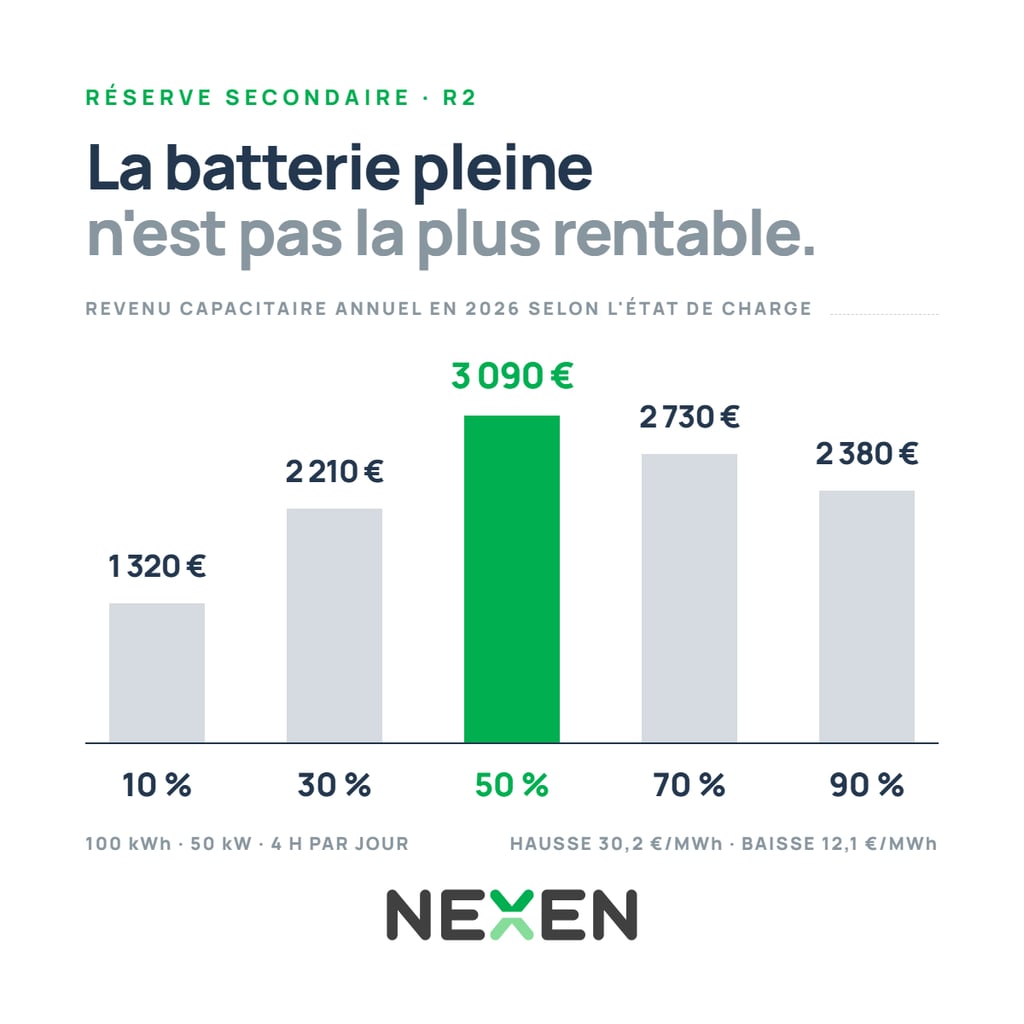
Take a typical case: a 100 kWh, 50 kW BESS committed 4 hours a day.
- At 90% state of charge: 50 kW upward but only 10 kW downward, around €2,380 over the year.
- At 30% state of charge: the reverse, 30 kW upward and 50 kW downward, or €2,210.
- At 50% state of charge: 50 kW in both directions, or €3,090.
A half-full battery is therefore worth more than a full one. It is the state of the stock at the time of commitment that creates the value, more than the installed power.
One access condition remains: the minimum bid is 1 MW. That means pooling and synchronising around twenty 50 kW sites, or a few hundred smaller residential batteries.
This barrier is the reason Nexen GridTech exists: we aggregate and control battery installations under 1 MW to open up access to these mechanisms.
Do you develop, distribute or install residential or commercial batteries? Get in touch to explore what the secondary reserve could bring to your projects.