
How much can a battery really earn from flexibility?
How much can a battery really earn from flexibility?
The honest answer: it depends.
In the past, the economics of solar projects were simpler and revenue was more predictable: on the one hand there were savings from self-consumption, and on the other the solar surplus was bought back at a good fixed price for 20 years.
Today, solar projects can no longer simply sell their surplus passively and still deliver a competitive return on investment. They need to become flexible, and stationary batteries make that possible.
A flexible solar installation requires smart control, because the economic equation to solve is more complex: you have to optimise both the site’s consumption and its participation in flexibility mechanisms.
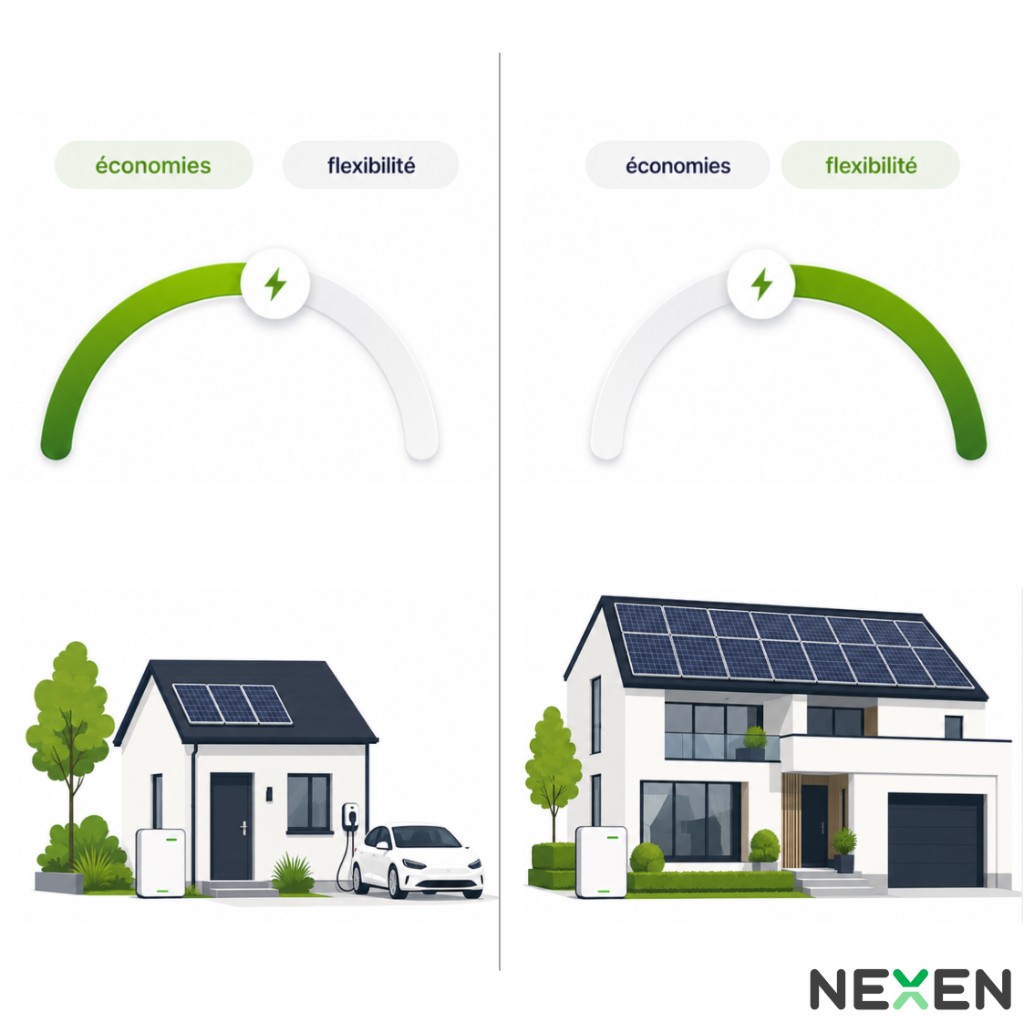
Indeed, two identical batteries installed on two different sites can have very different savings and revenue profiles, depending on the following parameters:
- The consumption profile.
- The solar generation profile.
- Electricity purchase prices.
- The grid connection capacity.
- The sizing of the PV array.
- The sizing of the battery.
- The quality of the data reported by the equipment.
- The materials the battery is made of.
And more besides.
In short, revenue does not depend on the battery alone but also, and above all, on the context in which it is installed. Then, the quality of its control and aggregation is what unlocks its full potential.
At Nexen GridTech, we analyse this context site by site to work out in concrete terms what a battery can earn, notably from flexibility, without overlooking the other value streams specific to each project.
Do you develop, distribute or install residential or commercial batteries? Get in touch if you would like a concrete assessment of the economic potential and flexibility revenue of your projects.