
Behind-the-meter batteries under 1 MW: earning money without charging or discharging?
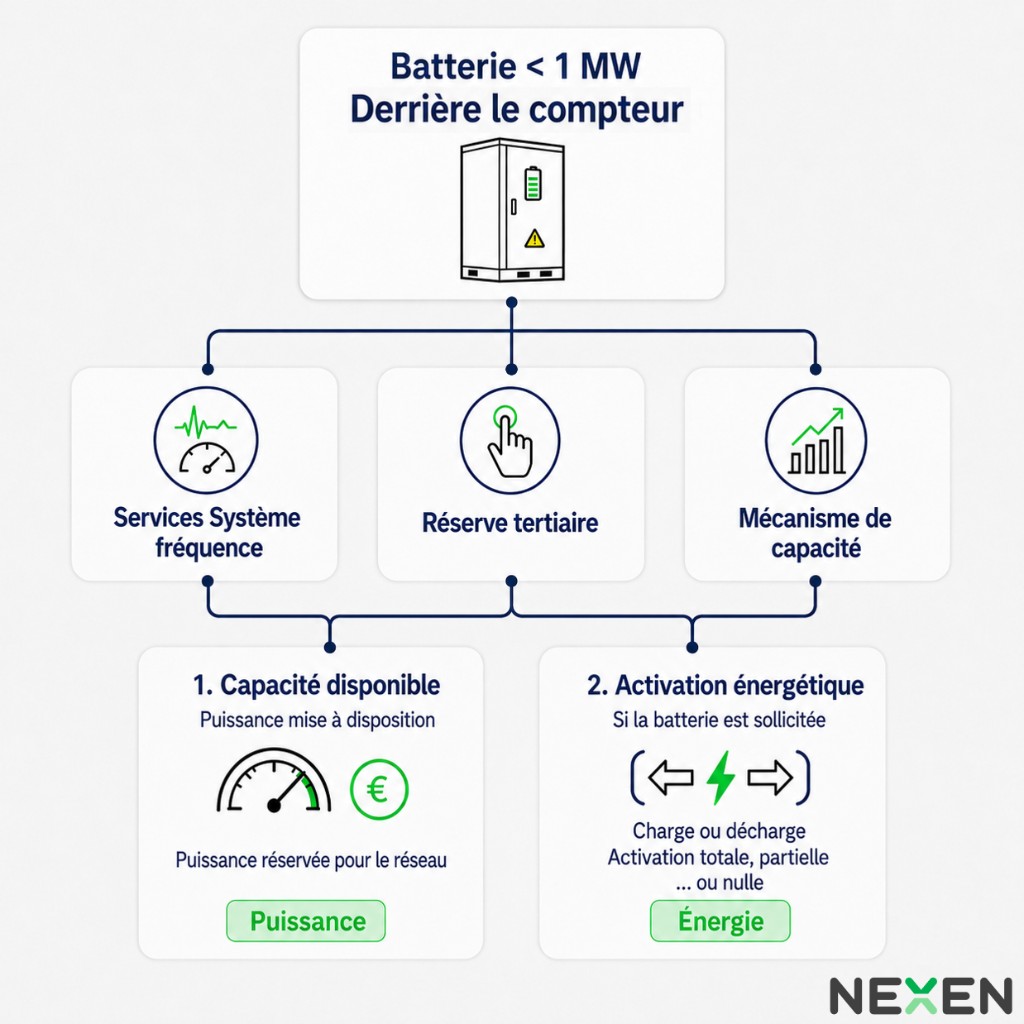
A battery can earn money even without charging or discharging!
Some flexibility mechanisms can pay a battery for the capacity it is able to make available to the power grid.
The battery commits to being available when needed. It may then be called upon to charge or discharge, fully, partially or not at all.
In practice, this is a form of insurance that the grid is willing to pay for, to counter potential imbalances between generation and consumption.
These mechanisms include:
-
Frequency ancillary services, including the primary reserve (FCR) and the secondary reserve (aFRR): reserves that can be mobilised quickly to stabilise grid frequency automatically.
-
The tertiary reserve, through the mécanisme d’ajustement (RTE’s balancing mechanism): activated manually, it takes over from the frequency ancillary services.
-
The capacity mechanism: a mechanism called upon during the periods when the power system is under the most strain, particularly winter peaks.
Today, taking part in these mechanisms can be particularly lucrative, especially the secondary reserve.
However, for a behind-the-meter battery under 1 MW to take part, several conditions must be met:
-
The battery must be able to follow a demanding control chain: reliable data, fast telemetry and control over how quickly setpoints are received and executed.
-
You need to be able to forecast how much capacity can be reserved for the grid without compromising the battery’s other uses, such as self-consumption and arbitrage.
-
These mechanisms require a minimum capacity. If a battery is too small to qualify on its own, it must be aggregated with other batteries so that its contribution can be monetised.
At Nexen GridTech, our role is to make batteries under 1 MW compatible with the requirements of these flexibility mechanisms: we secure the control, take account of the context around each battery and aggregate intelligently.
Do you install residential or C&I batteries? Get in touch to assess their revenue potential across these mechanisms.