Flexibility: what is the NEBCO mechanism and how can a battery take part?
Flexibility: what is the NEBCO mechanism and how can a battery take part?
A battery installed behind a consumer’s meter can be used to increase self-consumption if the site has solar panels. It can also generate additional revenue by taking part in flexibility mechanisms, NEBCO among them.
NEBCO, short for Notification d’Échanges de Blocs de Consommation (France’s demand-response block exchange mechanism), is a flexibility mechanism set up by RTE (the French transmission system operator) that lets participants monetise shifts in consumption on the energy markets.
There are two possible cases:
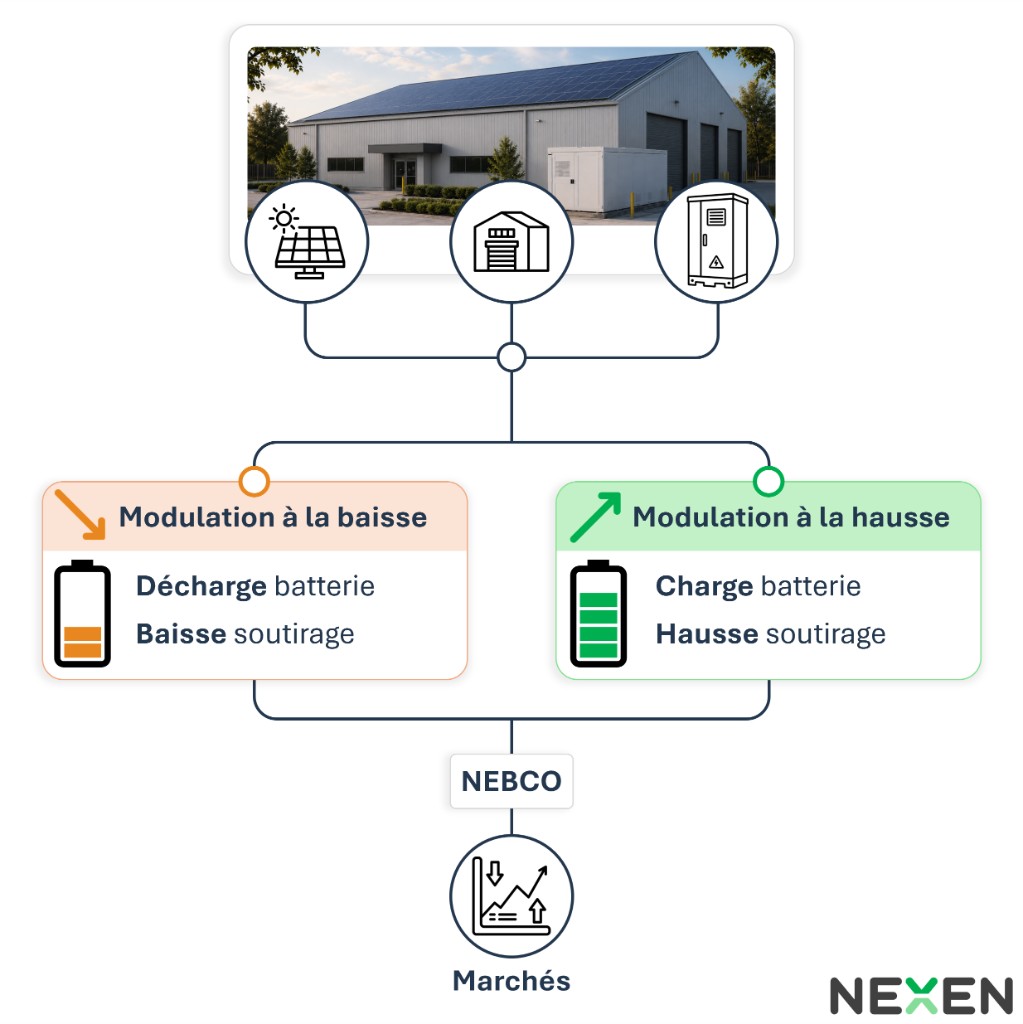
- Downward modulation:
The battery discharges to cover part of the site’s consumption.
As seen from the grid: the site withdraws less.
- Upward modulation
Possible since 1 September 2025, when NEBEF was replaced by NEBCO.
The battery charges, temporarily increasing the site’s consumption.
As seen from the grid: the site withdraws more.
NEBCO then turns this consumption modulation into blocks of energy that can be sold on the markets.
The energy markets where these blocks can be placed include:
-
The day-ahead (or spot) market, to take a position the day before on the next day’s prices.
-
The intraday market, to adjust a position within the same day, as close to real time as possible.
At Nexen GridTech, our virtual power plant (VPP) is built to let behind-the-meter batteries take part in NEBCO, as well as in other flexibility mechanisms.
Do you develop or install solar projects with behind-the-meter batteries? Get in touch if you are looking for alternatives to conventional feed-in tariffs.