Battery, solar panels and the feed-in premium: is flexibility really possible?
Battery, solar panels and the “complément de rémunération” (feed-in premium): is flexibility really possible?
Yes, but the project has to be designed for it from day one.
A little context:
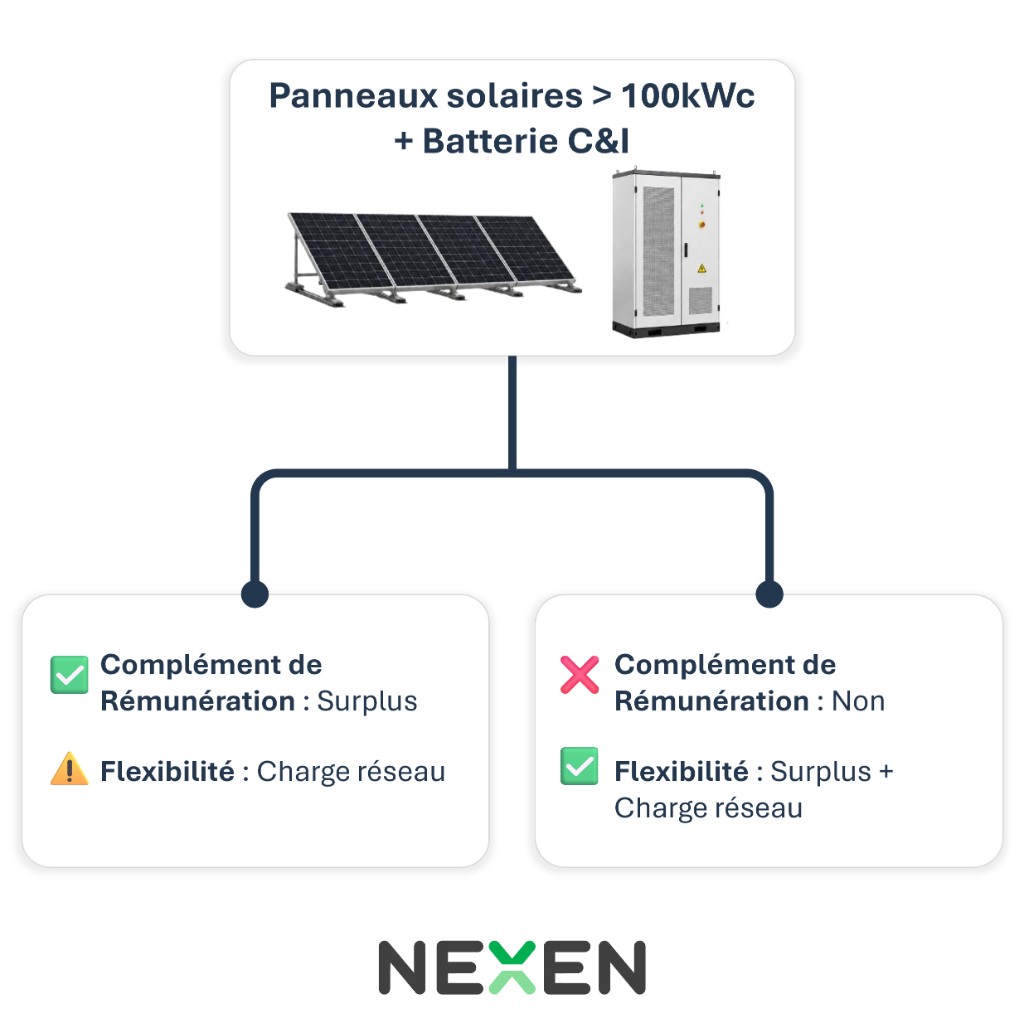
Above 100 kWp, new solar projects no longer fall under the S21 open-window feed-in contract with EDF OA (EDF’s purchase obligation department). They can instead bid in tenders for the feed-in premium (an AOS contract up to 500 kWp and an FV21 BCR contract above that).
Unlike S21 contracts for solar installations below 100 kWp, EDF OA does not buy the surplus solar directly at a fixed tariff. Instead:
- The solar electricity injected into the grid is first sold to a market operator chosen by the producer.
- EDF OA then pays the producer a feed-in premium on top of the revenue from the market operator’s sale, so as to stabilise their income around a reference tariff (subject to conditions).
Good news for batteries: unlike under S21, the law allows charging from the grid, provided the stored electricity withdrawn from the grid can be distinguished from the stored electricity generated by the solar installation (only the latter is eligible for the feed-in premium).
The battery can therefore be charged from and discharged to the power grid freely, allowing it to take part in the flexibility markets, even when the sun is not shining.
But this has to be planned from the outset: if the contract signed with the market operator does not allow a flexibility operator such as Nexen GridTech to step in and control the battery, fully monetising that flexibility can become complicated, or even impossible on some mechanisms. Conversely, without the feed-in premium, the project has no constraint linked to selling the surplus solar, and a 100% flexibility model can sometimes be more attractive.
At Nexen GridTech, our solution is designed to optimise battery control in each of these scenarios.
If you develop or install solar projects with batteries, contact us to compare these scenarios.