
How a battery under 1 MW takes part in flexibility
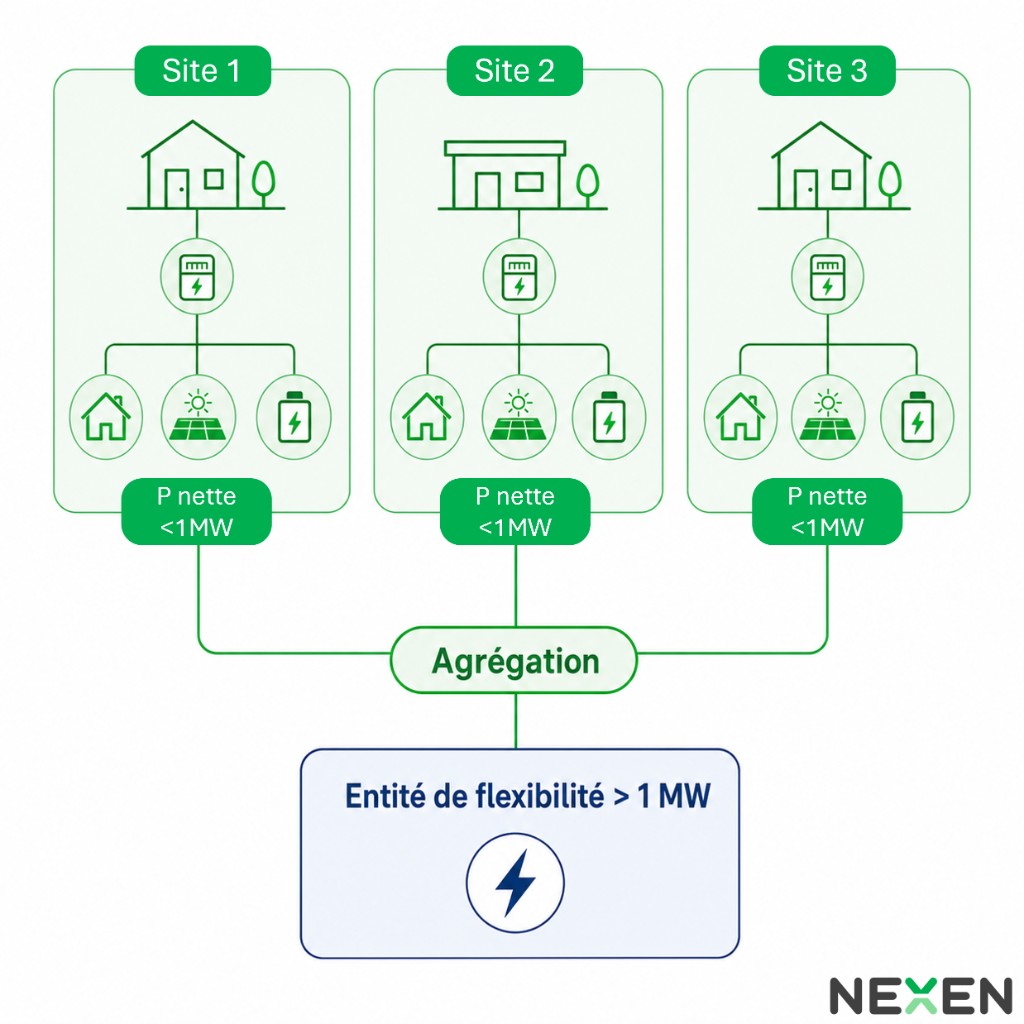
How can a behind-the-meter battery under 1 MW take part in flexibility mechanisms that require more than 1 MW?
We have touched on this before: a battery under 1 MW can earn revenue on the flexibility markets.
But it is worth going into a little more detail.
What the grid sees is not the battery itself, but what happens at the site’s meter.
In other words, it sees the site’s net power: consumption, any solar generation, and the battery charging or discharging.
Aggregation to reach the required market size
Most flexibility mechanisms require a minimum capacity of 1 MW to take part.
Sites whose flexible capacity is below 1 MW therefore have to be aggregated to form a market entity of sufficient size.
It is at the level of these aggregated entities that Nexen GridTech takes part in flexibility mechanisms.
Controlling each site contributes to the flexibility entity
Controlling each battery changes the net power of its site.
That net power then contributes to the available capacity of the flexibility entity the site belongs to.
To enable batteries under 1 MW to take part in flexibility mechanisms, Nexen GridTech has to manage each site’s energy flows precisely: consumption, any solar generation, and battery charging and discharging.
Balancing local optimisation against aggregated flexibility
Our virtual power plant (VPP) then has to strike a balance between two goals: optimising the site’s consumption locally, and committing part of its capacity to the aggregated flexibility entity.
Get in touch if you are planning battery installations under 1 MW and would like to assess the impact of Nexen GridTech’s control on their profitability.