
BTM or FTM battery: what is the difference?
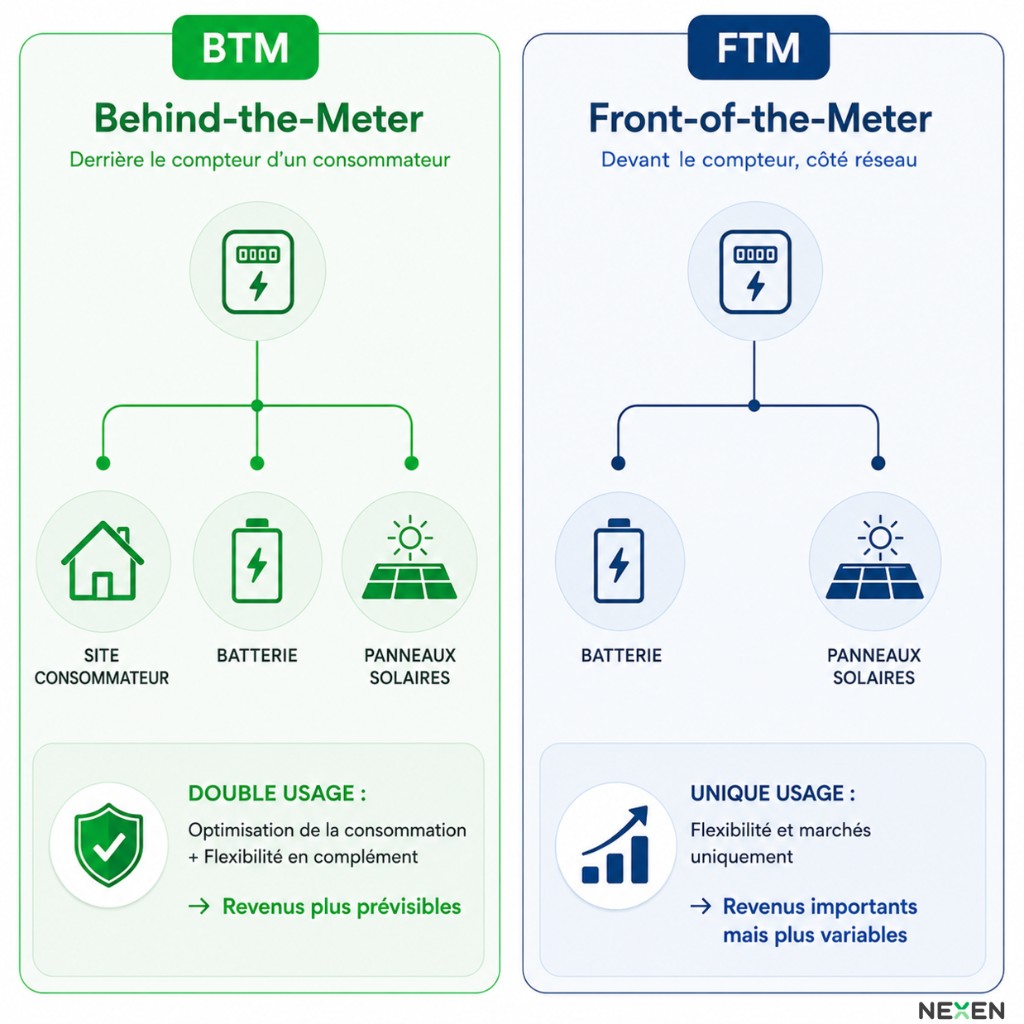
Behind-the-meter (BTM) or front-of-the-meter (FTM) battery: what is the difference?
A battery can be installed in two ways:
-
Behind the meter: the battery is installed behind a consumer’s meter.
-
Front of the meter: the battery is not attached to a consumer’s meter and has its own meter.
In both cases, the battery stores and releases electricity, but its business model is not the same.
BTM
Behind the meter, a large share of the value comes from optimising the site’s electricity bill:
This optimisation can draw on several levers:
- Optimising solar self-consumption.
- Charging during off-peak hours to supply the site during peak hours.
- Reducing occasional peaks in power demand.
BTM often offers a robust business model.
A substantial share of the return comes from the savings the battery delivers. This value is also fairly predictable and can potentially justify much of the consumer’s investment in the battery.
Flexibility then adds a further pillar of value. When the battery is not needed to optimise the site’s consumption, it can be put at the service of the power grid to improve its return even further.
FTM
Front of the meter, the logic is different:
The battery is directly exposed to the grid and is 100% dedicated to flexibility mechanisms.
The gains can be significant, but profitability inevitably depends on less predictable factors: electricity prices, the needs of the power grid, and so on.
In short, at Nexen GridTech, behind the meter our role is to optimise battery control between the site’s needs and flexibility opportunities.
Front of the meter, our role focuses on maximising earnings on the flexibility markets.
Get in touch if you would like to assess the technical and economic impact of Nexen GridTech’s control on your BTM or FTM projects under 1 megawatt.